
Introduction
Studying effectively is not just about spending long hours with books; it is about using the right strategies to understand, remember, and apply information. Many students spend hours preparing for examinations but struggle to recall what they have learned. The solution is to develop effective study habits, manage time wisely, and use techniques that support long-term learning. Research highlights the importance of strategies such as spaced practice and self-testing in improving learning and memory.
1. Set Clear Study Goals
Before beginning a study session, decide what you want to accomplish. Instead of setting a general goal such as “study mathematics,” choose a specific target, such as solving ten practice questions or understanding one chapter.
Clear and realistic goals help students remain focused, track their progress, and avoid wasting time. Breaking large tasks into smaller steps also makes challenging subjects feel more manageable.
2. Use Active Recall
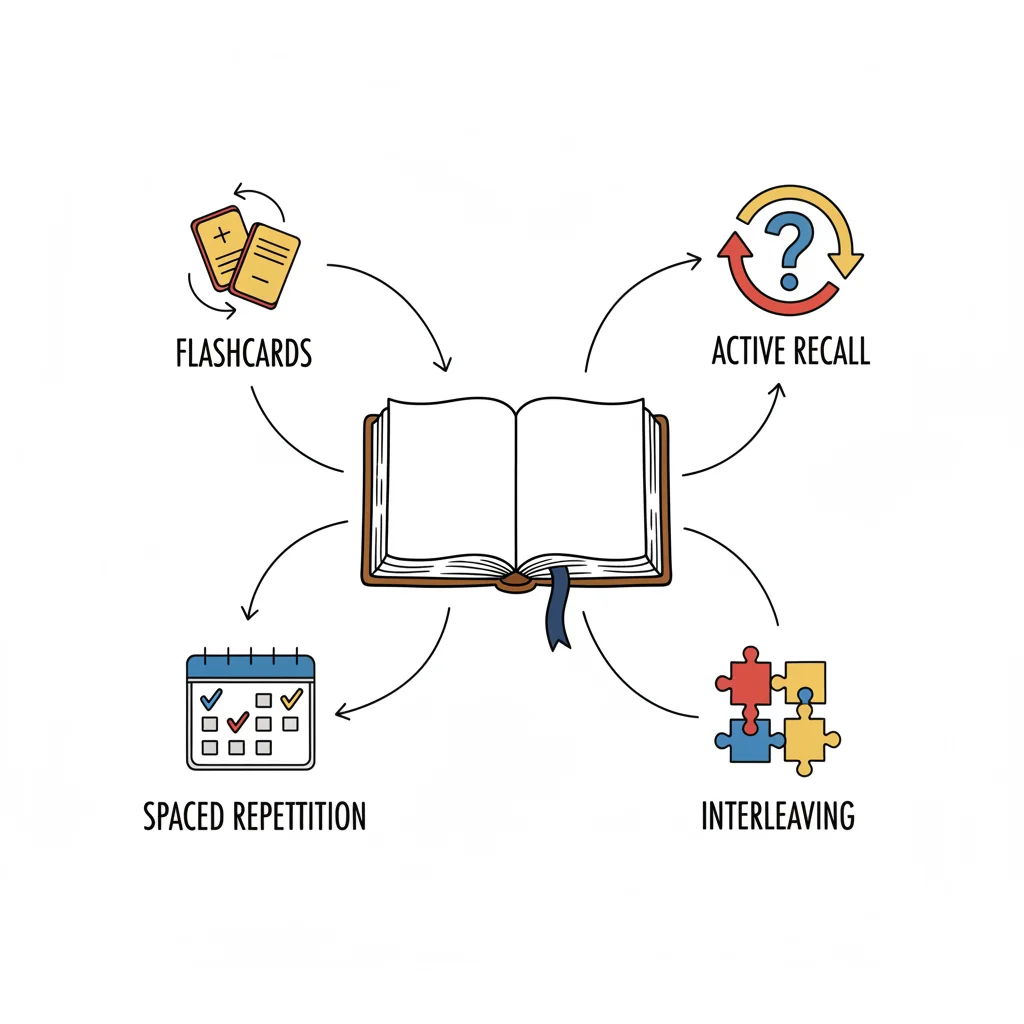
Active recall is one of the most useful study techniques. It involves retrieving information from memory instead of simply reading the same material repeatedly.
After studying a topic, close your book and try to explain the main ideas in your own words. You can also answer practice questions, use flashcards, or write everything you remember on a blank sheet of paper.
This technique helps identify gaps in understanding and strengthens the ability to recall information during examinations.
Practical tip: After completing a chapter, write down five questions about its main concepts and answer them without looking at your notes.
Learn more: University of California San Diego — Retrieval Practice
3. Practise Spaced Repetition
Spaced repetition means reviewing information at intervals rather than trying to learn everything in one sitting. Studying a topic several times over a period of days can help students retain information for longer.
For example, after learning a new topic, review it the next day, revisit it a few days later, and test yourself again the following week. Adjust the intervals according to how difficult the topic is and how well you remember it.
This approach is particularly useful for learning definitions, formulas, vocabulary, historical dates, and scientific concepts.
Learn more: The Learning Scientists — Spaced Practice and Learning Strategies
4. Create a Realistic Study Timetable
A study timetable helps students organise their workload and prepare for examinations without unnecessary stress. Allocate specific periods for each subject, giving extra time to difficult topics and upcoming assessments.
Include short breaks and leave some time for revision. A timetable should be realistic and flexible enough to accommodate classes, assignments, family responsibilities, and rest.
One simple approach is to study for 25 minutes and then take a five-minute break. After several sessions, take a longer break if needed. This method, commonly known as the Pomodoro Technique, can help students structure their study time.
The key is to focus on completing planned tasks rather than merely counting the hours spent studying.
5. Understand Concepts Instead of Memorising Everything
Memorisation has its place, but understanding is essential for applying knowledge to new questions and situations. When learning a concept, ask yourself: What does it mean? Why does it work? How is it connected to what I already know?
Try explaining difficult ideas in simple language, creating examples from everyday life, or teaching the topic to a friend. If you cannot explain a concept clearly, revisit the material and identify what you have not understood.
For subjects such as mathematics, computer science, and accounting, combine conceptual understanding with regular problem-solving practice.
6. Make Short and Useful Notes
Effective notes should make revision easier, not reproduce an entire textbook. Identify the main ideas, important definitions, key arguments, formulas, and examples.
Use headings, bullet points, comparison tables, diagrams, and mind maps where appropriate. These formats can help you organise information and recognise relationships between concepts.
After preparing your notes, use them to test your memory rather than relying on reading them repeatedly. Keep your notes accurate and concise so that you can revise important information quickly before an examination.
7. Practise with Past Papers and Sample Questions
Practice questions help students understand how knowledge is tested and where improvement is needed. Past papers, sample questions, and mock examinations can familiarise students with question formats and help them practise managing time.
After completing a practice test, check your answers carefully. Identify mistakes, understand why they occurred, and practise similar questions until you can solve them independently.
Do not focus only on the marks you receive. Pay attention to the topics you find difficult and use those results to plan your next study session.
8. Reduce Distractions
Concentration is an important part of effective learning. Frequent notifications, social media, unnecessary browsing, and multitasking can interrupt study sessions.
Keep your phone away or silence notifications while studying. Choose a comfortable, well-lit study space and keep the materials you need nearby. If your environment is noisy, consider using earplugs or moving to a quieter place.
For online learners, it is helpful to close unrelated browser tabs and use digital tools only when they support the task.
9. Study Different Subjects with Different Methods
Not every subject requires the same approach. Choose techniques according to the type of learning involved.
- Mathematics and accounting: Solve problems, practise calculations, and review mistakes.
- Science: Understand processes, draw diagrams, and explain cause-and-effect relationships.
- Languages: Practise vocabulary, writing, speaking, and reading regularly.
- History and social sciences: Build timelines, compare ideas, and practise explaining events and arguments.
- Computer science: Write code, solve practical problems, and explain how algorithms work.
Combining suitable techniques with self-testing and spaced revision can make study sessions more productive.
10. Take Care of Your Physical and Mental Well-Being
Good study habits also depend on adequate rest and a healthy routine. Sleep supports learning and memory, while regular meals, hydration, and physical activity can help maintain energy and concentration.
Avoid making all-night study sessions your regular examination strategy. Although last-minute revision may feel productive, it can leave you tired and less prepared to concentrate during an examination.
Take breaks when needed and seek help from teachers or classmates when a topic remains difficult. Consistent effort is generally more sustainable than studying under constant pressure.
A Simple Weekly Study Plan
Students can begin with a straightforward routine:
- Day 1: Learn a new topic and make concise notes.
- Day 2: Review the topic and answer questions from memory.
- Day 3: Practise problems or explain the concepts aloud.
- Day 4: Revisit difficult areas and correct mistakes.
- Day 5: Complete a short practice test.
- Day 6: Review weak topics and test yourself again.
- Day 7: Summarise the week’s learning and plan the next week.
This is a sample schedule, not a fixed rule. Students should adjust it according to their subjects, workload, and examination dates.
Conclusion
Effective studying is a skill that develops through practice and consistency. Setting clear goals, using active recall, revising at spaced intervals, practising examination questions, and reducing distractions can help students make better use of their time. Rather than focusing only on how long they study, students should focus on how well they understand and remember what they learn.
Start with one or two techniques, practise them regularly, and gradually build a study routine that suits your needs. With patience, organisation, and consistent effort, studying can become more manageable and productive.
Further Reading and Educational Resources
Explore these reliable resources to learn more about effective study techniques:
- University of California San Diego: How to Effectively Study
- Cornell University: Effective Study Strategies
- The Learning Scientists: Six Strategies for Effective Learning
- Nature Reviews Psychology: The Science of Effective Learning with Spacing and Retrieval Practice
- Australian Education Research Organisation: Spacing and Retrieval Practice Guide
These resources provide additional research-based guidance for students who want to improve their learning habits and academic performance.